
By Shawn Ennis | Rapax
You already know which tools you want to eliminate. You signed those contracts five, ten, maybe fifteen years ago. They made sense at the time. A fault management system from one era. A performance management platform from another. A ticketing integration built by a systems integrator who is no longer on retainer. An element management system the vendor stopped investing in three releases ago.
You have been writing checks for all of them every year since. Annual maintenance on software that no longer matches how the network operates. Infrastructure hosting for platforms you would decommission tomorrow if you could. SI professional services hours to keep integrations functioning between systems that were never designed to work together.
Here is the thing nobody says out loud in procurement conversations: the budget to replace those tools is not new money. It is already being spent. It is trapped inside the contracts you have and the operational overhead they generate. The question is not whether you can afford to replace them. It is whether you can afford to keep paying for them.
What a Legacy Tool Actually Costs
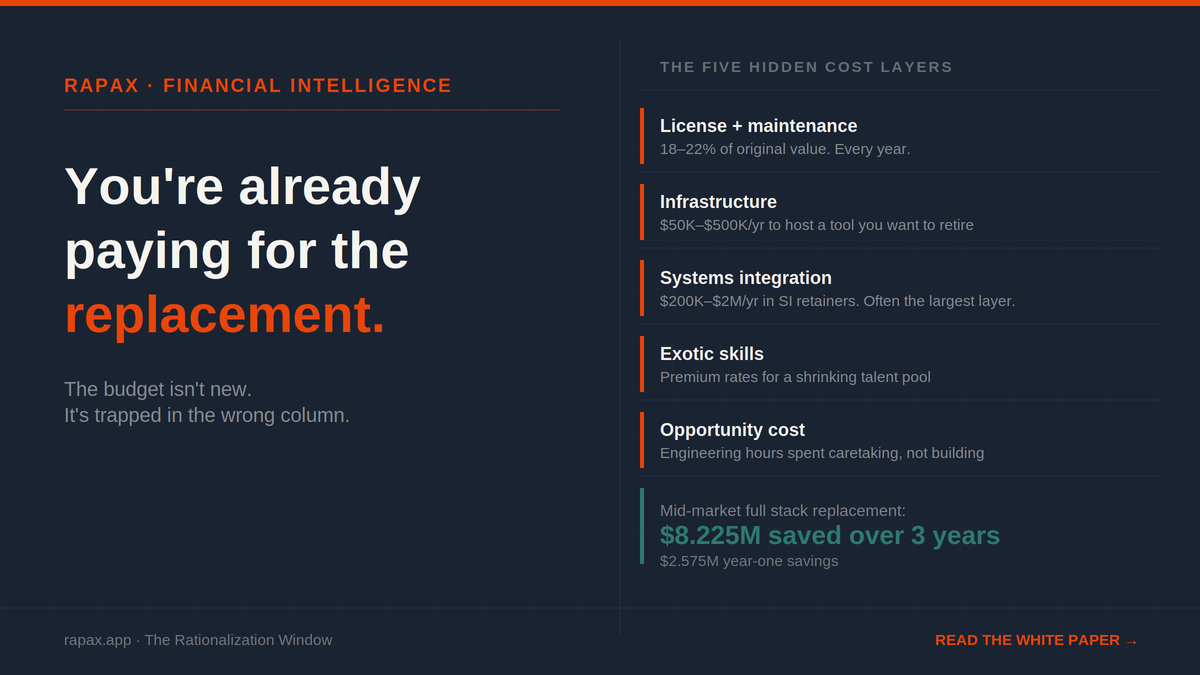
The license fee is the number that appears on the invoice. It is not the number that matters. The true cost of a legacy OSS/BSS tool is the sum of five layers — and most operators have never added them up as a single figure.
License and maintenance. Enterprise OSS/BSS platforms carry annual maintenance fees typically ranging from 18% to 22% of the original license value. A platform originally licensed at $1 million costs $180,000 to $220,000 per year in maintenance alone — paid regardless of whether the operator uses 100% of its capabilities or 20%. Most operators use considerably less than 100%.
Infrastructure. Legacy platforms require dedicated compute, storage, and database infrastructure. Servers age. Operating systems go end-of-life. Database licenses add their own maintenance streams. The infrastructure cost of running a single legacy OSS platform runs from $50,000 to $500,000 annually — infrastructure that exists solely to host a tool the operator wants to retire.
Systems integration. This is the cost layer most operators undercount, and it is often the largest. Every integration between a legacy tool and the rest of the operational environment — ticketing, provisioning, billing, element management — was built by a systems integrator or internal engineer, and it requires ongoing care. When an upstream platform pushes an upgrade, the integrations must be regression-tested. When a downstream system changes its API, the integrations must be rebuilt. Operators routinely spend $200,000 to $2,000,000 per year on SI retainers and project work to keep legacy integrations functioning.
Exotic skills. Legacy platforms create skill dependencies that become more expensive over time, not less. The talent pool for platforms built on proprietary rule engines, Perl-based correlation logic, or decade-old Java frameworks shrinks every year. When the one internal engineer who understands the platform leaves, the operator faces a choice between an expensive contractor and a risky knowledge gap.
Opportunity cost. Every dollar spent maintaining a tool you do not want is a dollar not spent on a tool you need. Every engineering hour spent caretaking legacy software is an hour not spent on network modernization, customer experience improvement, or competitive differentiation. This cost never appears on a line item, but it compounds relentlessly.
The Replacement Math for a Mid-Market Operator
Consider a representative mid-market operator replacing their complete service assurance stack — fault management, performance management, correlation, analytics, and associated integrations. This is not a hypothetical; it is a scenario we have modeled against real operator environments.
Current annual spend: three separate platforms with their own licenses, maintenance, infrastructure, and integration overhead, plus two full-time engineers spending the majority of their time maintaining those platforms and their integrations rather than performing network engineering. Total: $4.1 million per year.
With an AI-native platform consolidating all assurance functions: $1.525 million in year one, including a one-time onboarding investment. Year-one savings: $2.575 million. Year two and beyond: $2.825 million annually. The two FTEs previously dedicated to platform maintenance are freed to perform network engineering, capacity planning, or high-value work. SI costs are eliminated entirely as the integration architecture shifts from point-to-point to platform-native.
Three-year savings: $8.225 million.
That is not a projection built on optimistic assumptions. It is the arithmetic of eliminating five cost layers and replacing them with one.
Why the Tools Persist Despite the Math
If the replacement math is this clear, why do the tools persist? Every VP of Engineering and CFO I have talked to over the past 25 years has known which tools they wanted to eliminate. The answer is consistent: replacing them has historically meant a multi-year, multi-million-dollar transformation program with its own risks, its own SI costs, and its own disruption to live operations. The cure has always seemed as expensive as the disease.
That calculation has changed. AI-native platforms that can absorb the functions of legacy OSS/BSS tools incrementally — not as a big-bang replacement, but as a phased migration that delivers savings with every tool decommissioned — make it possible to turn the money you are already spending into savings that fund their own replacement.
You do not need to replace everything at once. You start with the tool that costs the most relative to the value it delivers. You decommission it. The savings from that decommission fund the next phase. The budget is already there. It is just in the wrong column.
“The budget to fund an AI-native replacement is not new money. It is trapped inside maintenance contracts, infrastructure hosting, SI retainers, and skills premiums for tools the operator already wants to eliminate.”
The Starting Point
The most useful thing you can do with the next 15 minutes is add up the five cost layers for the tool you most want to eliminate. Not the license fee — all five layers. License, infrastructure, SI, exotic skills cost, and a rough estimate of the engineering hours consumed by caretaking. That number is the budget for the replacement conversation.
The full financial model — three scenarios from single tool replacement to full operational transformation, with line-item cost comparisons at each level — is in the white paper below.
The Rationalization Window
Turning OSS/BSS Tool Sprawl Into AI-Native Savings
If any of this lands and you want to map your current tool landscape against the replacement math — 15 minutes at cal.com/shawn-ennis. No prep needed.
Leave a Reply