
Everything a NOC needs. None of the platform team.
Rapax 2.0 puts log collection, polling, correlation, root cause, service impact, ticketing and SLA reporting in one hosted platform. It is built so one NOC manager runs it in a couple of hours a week (our design target), and you can try it free for 14 days on your own network.
Hosted for you in the US, Canada, Mexico or Europe. A login to your own system within two business days.
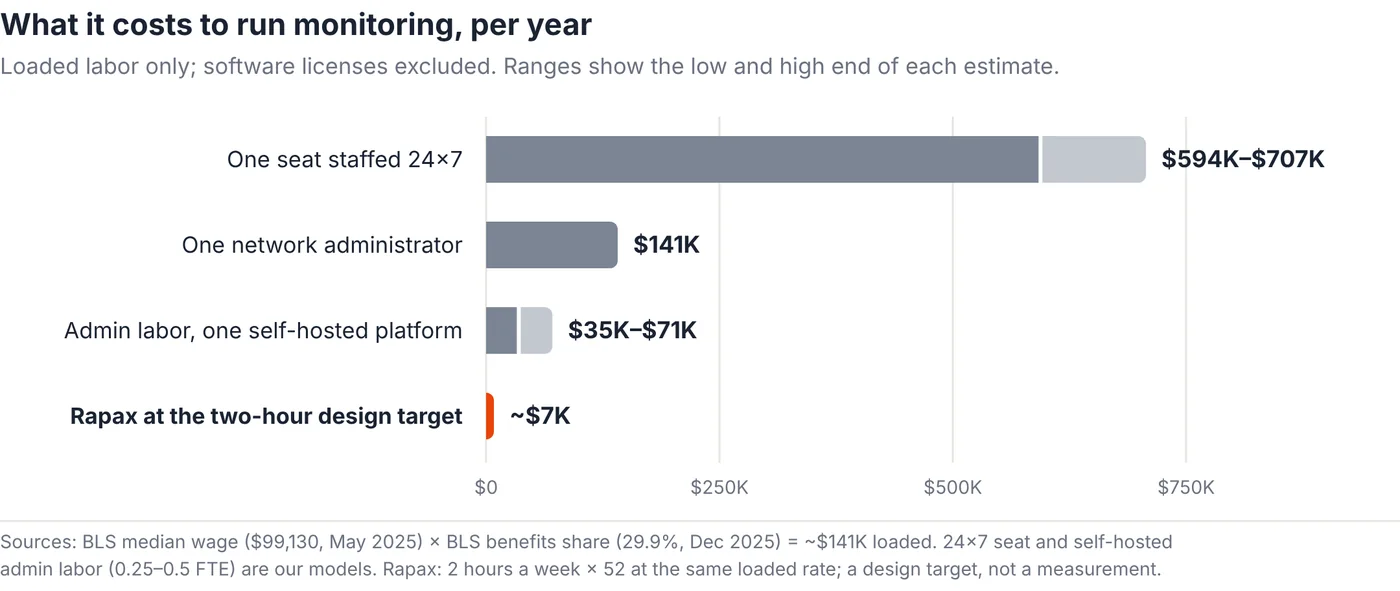
The license is the cheapest part.
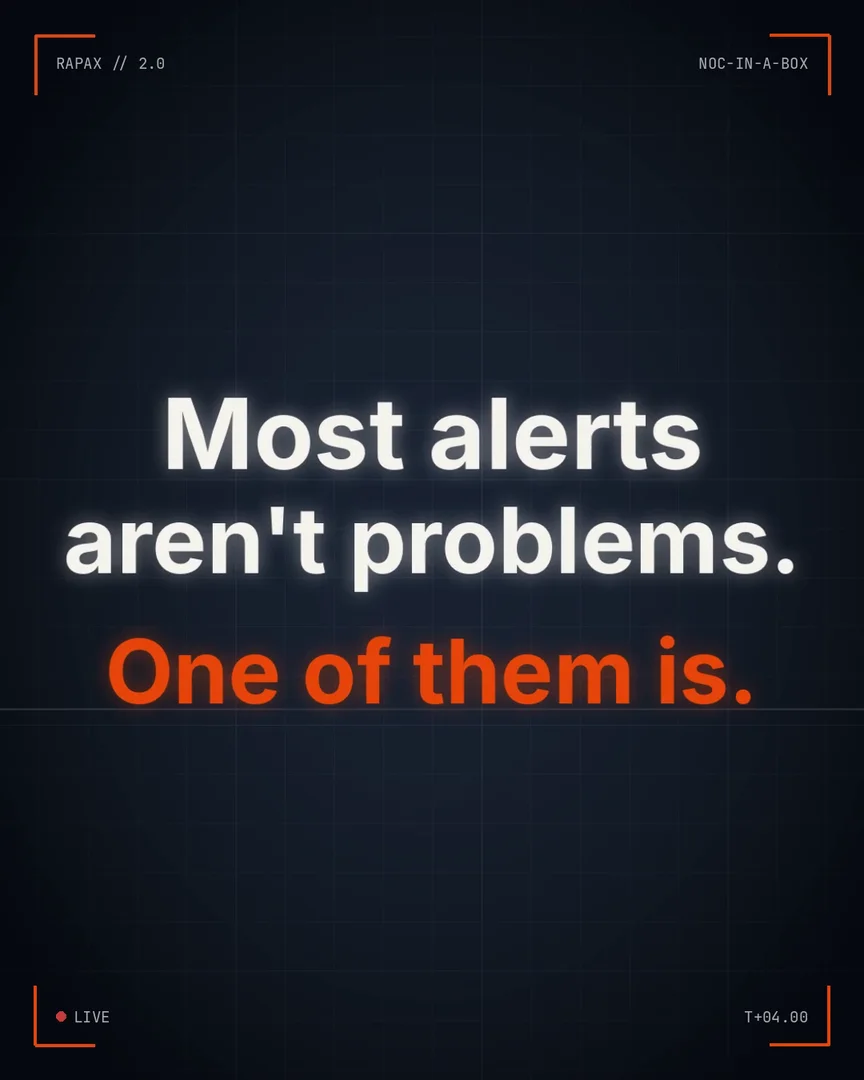
Most teams don’t struggle with monitoring because their tools lack features. They struggle because running the tools takes expertise they can’t hire, and the people they have are needed on the network.
Running the tools costs more than buying them.
Every monitoring tool brings its own upgrades, certificates, backups, integrations and credentials. The typical IT organization runs 4 to 10 of them. We estimate that one self-hosted platform takes a quarter to half of a person to keep alive.
Rapax 2.0 is one platform with one thing to administer, and the administration runs from the browser.
One platform where you used to run several.
NOC-in-a-Box is the real-time operations stack in one hosted system, plus the AI agents and setup hours to put it to work. Your team still makes the calls. Rapax does the watching, sorting and paperwork.
Log collection
Syslog and SNMP trap receiver, search, live tail and export.
Polling
Ping and SNMP v2c/v3 with latency and loss, plus a discovery wizard.
Correlation and root cause
Parent/child, topology and service correlation. Root cause is one click away.
Service impact
Every alert mapped to the business services and customers it affects.
Availability and SLA
Targets, error budgets and scheduled reports per device and service.
Analytics
Baselines, anomaly detection and capacity forecasts that give you a date.
Ticketing and portal
Native incident management, a customer portal and an AI tier-1 agent.
Knowledge
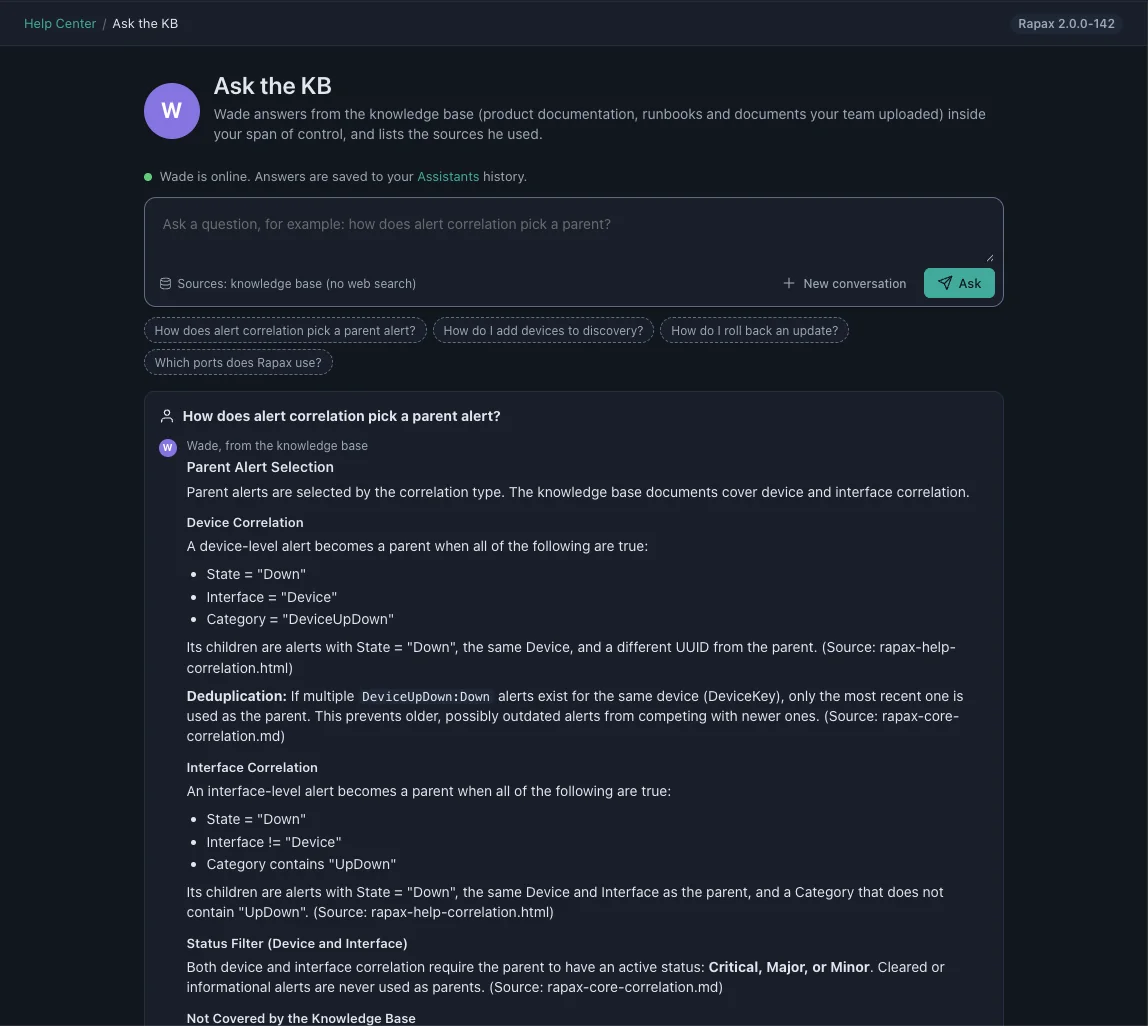
Answers grounded in your own runbooks, with the source cited.
One problem, not three alerts.
Detect
A remote collector reports the failure to Rapax over TLS.
Correlate
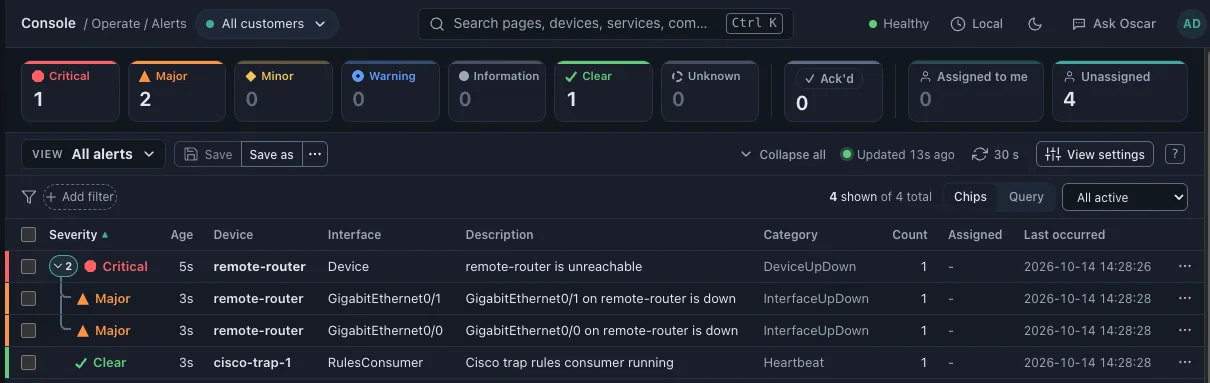
Downstream alerts nest under one parent: a router outage and its two failed interfaces show as one critical problem.
Show impact
The alert names the business service that is down and the customers on it.
Answer
Ask what to do and get the answer from your own runbook, with the source cited.
Update
The AI tier-1 agent updates the ticket and the customer portal.
Close
An administrator confirms the fix. No command line, no specialist.
A couple of hours a week. Design target
Most assurance platforms assume a dedicated team behind every install. Rapax 2.0 assumes you don’t have one.
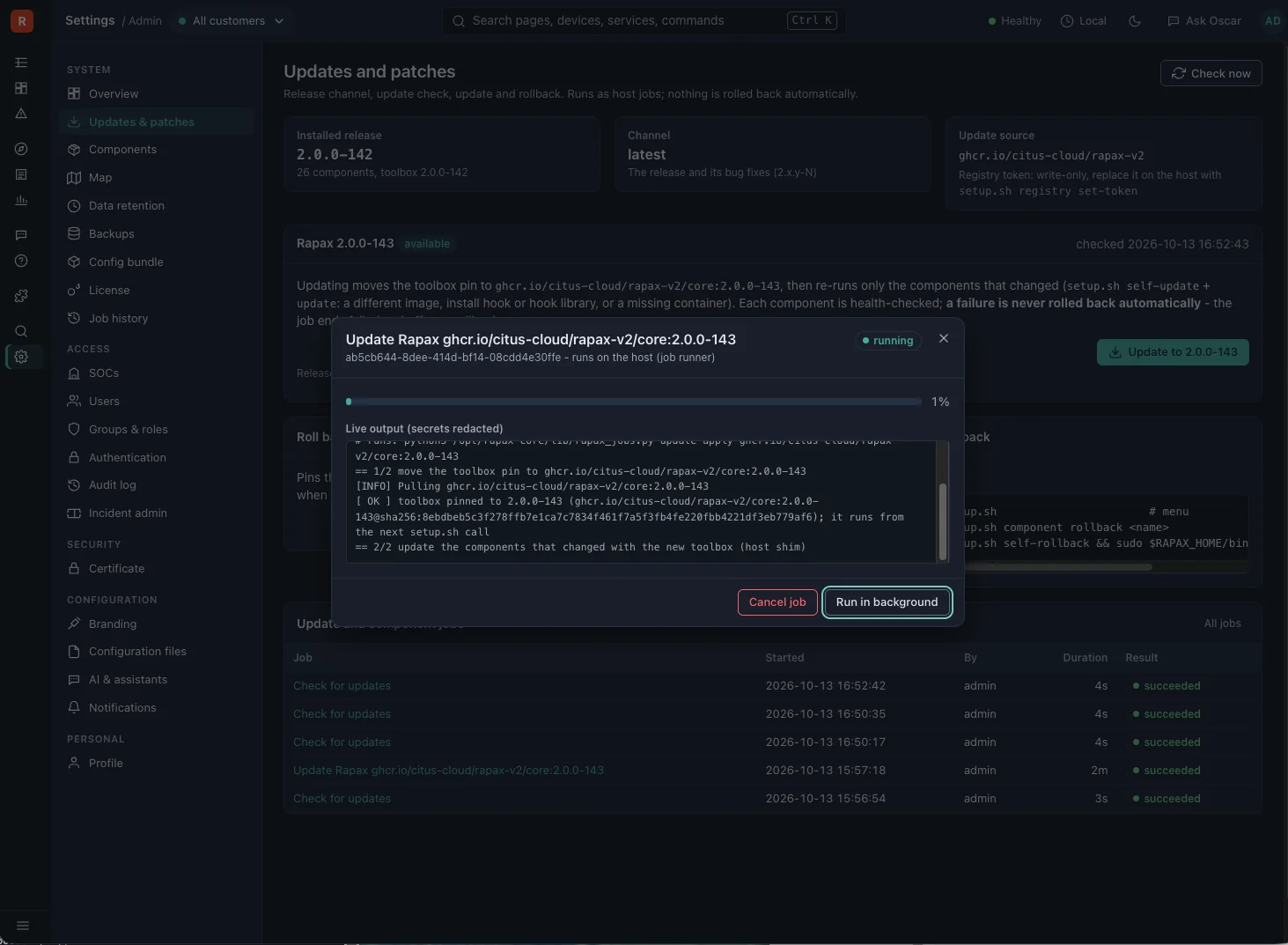
- Updates and patches in one click, with a snapshot first and rollback if anything fails
- Backups and Let’s Encrypt certificates that look after themselves
- New devices found by discovery and held until you approve them
- Users, collectors, reports and components managed from the browser
The two-hour week is our design target for running the tools, not a measurement and not incident work. Test it during your evaluation.
Built for teams that run networks without a platform team.
IT operations
A 40-person IT department doesn’t need four monitoring tools and a specialist for each. Get the coverage of several tools with the administration of one.
Managed service providers
One platform, every customer in their own locked view, with their own branding, reports and support portal. You do not need expensive, complex tools to run an MSP.
Service providers
Fiber cuts, PON outages and subscriber impact in one alert, built from the network drawings you already have.
Tested at release. Proven in production telecom.
Release quality
Rapax 2.0 passed all 46 of its test suites at general availability: 4,475 checks, zero failures. ZAP/OWASP security testing is part of every release.
Production telecom
Before 2.0, a mid-market fiber ISP serving more than 600,000 subscribers deployed Rapax against its existing Kafka streams. The initial deployment took under two hours, with no device agents and no schema changes.
Industry showcase
Demonstrated at TM Forum DTW Ignite 2026 in a multi-vendor Catalyst: three sites, 113 devices and six equipment vendors.
Built by people who did this before
Rapax is led by founder Shawn Ennis, who spent 25 years building service assurance platforms and founded Assure1, acquired by Oracle in 2021.
- EMA Network Management Megatrends 2026: 52% struggle to hire and keep network engineers (26% in 2022).
- Network World on EMA 2026: 37% of alerts point to a real problem; 4 to 10 tools per organization.
- BLS Occupational Outlook, network and computer systems administrators (median wage $99,130) × 1/(1−0.299) from BLS Employer Costs for Employee Compensation, December 2025 (benefits 29.9% of compensation) = about $141,000. Our arithmetic.
- Platform administration at 0.25–0.5 of a person is our estimate from field experience, not a survey figure.
Days, not quarters.
No servers to approve, no integrator to hire, no RFP. Fill in a short form and see correlated alerts on your own devices.
Request
Tell us your size, region and devices. It takes about three minutes, and we never ask for passwords or API keys.
Sign in
Within two business days you get a login to your own hosted Rapax system. The Get Started guide walks you through setup.
Decide by day 14
Keep it with a license install and everything you built stays. Or walk away and owe nothing.
Run the network, not the tools.
Request your free 14-day evaluation and get a login to your own Rapax system within two business days.
Request your free evaluationPrefer to talk first? Book 15 minutes or email sales@rapax.us.