
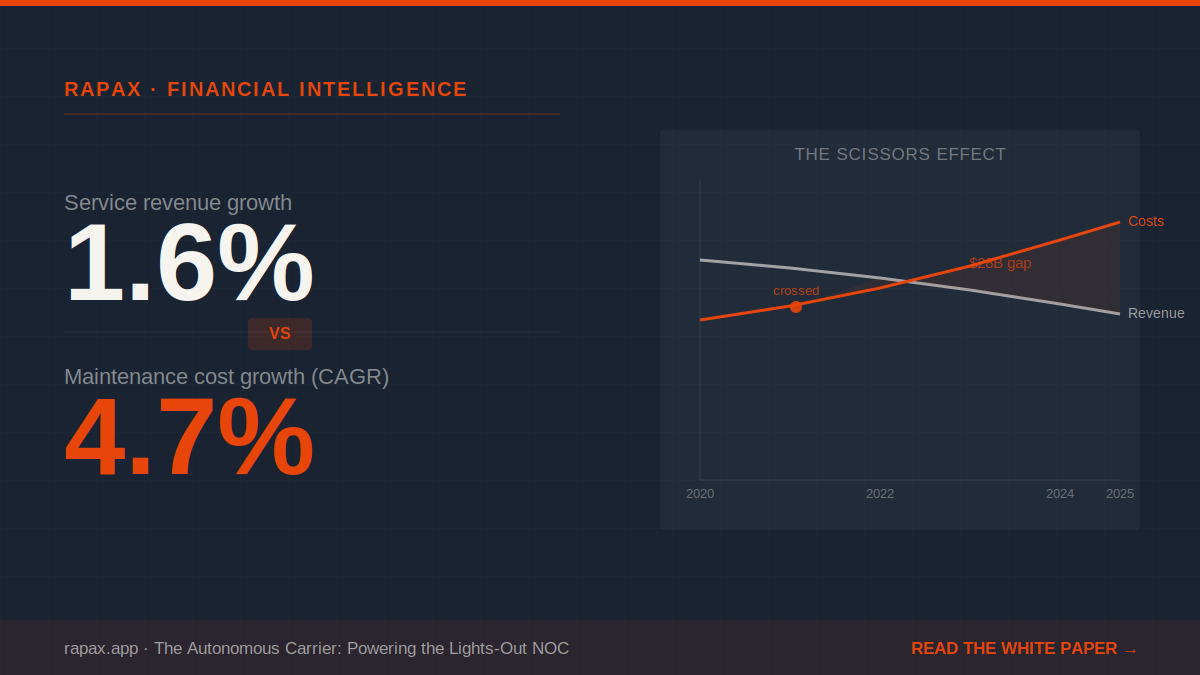
Your Revenue Is Growing at 1.6%. Your Maintenance Costs Are Growing at 4.7%
Those two numbers are not a footnote. They are the entire story of where telecom operating margins are going — and why every efficiency initiative, headcount freeze, and vendor renegotiation your finance team has run in the last three years has not been enough to close the gap.
Let me put them in context.
In 2024, worldwide telecom service revenue grew by 2.2%. Projections for 2025 put that figure at 1.6% — and the trend line is not pointing up. At the same time, the global market for telecommunications network infrastructure maintenance reached $32.4 billion in 2024 and is projected to grow at a compound annual rate of 4.7% through 2031. That is maintenance costs accelerating at nearly three times the rate of revenue growth.
This is what the industry calls the Scissors Effect. And if you are a CFO, COO, or VP of Operations at a network carrier, you are feeling the blades.
The $28 Billion Gap
The Scissors Effect is not a forecasting abstraction. It has a dollar figure attached to it. Recent industry analysis shows a widening $28 billion gap between estimated free cash flow across the sector and the capital required to meet market valuation expectations. That gap is not a temporary dip driven by a bad quarter or an unusual capex cycle. It is the structural output of an operational model that was designed for a different economics — one where revenue grew faster than the cost of running the network.
That model no longer holds. Revenue per bit has been declining for decades as broadband commoditizes. The cost of maintaining layered, heterogeneous infrastructure — accumulated across every technology wave from copper to fiber to 5G — has not declined with it. The two trend lines crossed somewhere in the last five years, and now the gap is widening every quarter.
The finance team can see it in the OpEx Intensity Index — the ratio of operating expenses to total revenue — which has climbed into an unsustainable range for a significant portion of North American carriers. Every VP Engineering is being asked to do more with flat or shrinking headcount. Every CFO is being asked to explain to the board why margins are compressing even as subscriber counts hold steady.
The answer is not complicated. The cost of keeping the network running is growing faster than the network’s ability to generate revenue. And the primary driver of that cost is human labor applied to tasks that do not need to be human.
The Human Bottleneck Is Not a People Problem
This is the part of the conversation that gets misread. When I say the operational model is broken, I am not saying the people running it are the problem. I spent 25 years working alongside the engineers and operations leaders who run these networks. They are skilled, committed, and doing exactly what the operational model asks of them.
The problem is what the model asks of them.
Roughly 85% of human-error-related outages are caused by staff failing to follow or misinterpreting complex procedures — not because those staff members are incompetent, but because complex procedures applied to heterogeneous infrastructure at scale will produce errors at a statistically predictable rate. That is not a training problem. It is an architecture problem.
Similarly, the allocation of engineering labor to low-value repetitive tasks — alarm triage, ticket routing, configuration verification, scheduled health checks — is not a hiring problem. It is a model problem. Elite engineering talent is expensive, and the current operational model consumes the majority of that talent on work that does not require elite judgment. The high-value work — network architecture, capacity planning, new product enablement — is what gets deferred.
The result is a workforce that is simultaneously overworked and underutilized. Overworked on janitorial tasks. Underutilized on the strategic work that actually grows the business.
What Decoupling Actually Looks Like
The carriers that survive the Scissors Effect will be the ones that decouple their operational costs from their network scale. The goal is to be able to double the network footprint without doubling the NOC headcount — to grow revenue without growing the maintenance cost base at the same rate.
The mechanism for that decoupling is not another round of script automation or static playbook deployment. Those approaches — Automation 1.0, as I think of them — reduce some friction at specific known failure modes. They do not handle the novel event. They do not reason across layers. They do not adapt when the situation deviates from the script.
What changes the economics is an agentic operational model: AI agents that understand the intent of the network, reason through complex multi-variable events, and execute remediations end-to-end without waiting for a human to triage, decide, and act. When a fiber backhaul is severed, the agent does not open a ticket and wait — it reroutes traffic, adjusts wireless beamforming on adjacent cell sites to compensate for lost capacity, initiates the RMA for the affected hardware, and schedules the field technician. The human reviews what happened, not what to do next.
That is what closes the gap between 1.6% revenue growth and 4.7% maintenance cost growth. Not incrementally — structurally.
The Window Is Not Permanently Open
In 2026, the gap between AI-native carriers and legacy operators is becoming a competitive chasm. The carriers that move first on this model will compound the advantage — lower operating costs fund faster network expansion, which generates more revenue, which funds further automation investment. The carriers that wait are funding that advantage for their competitors with every quarter they stay on the current model.
The full economic case — what the Lights-Out NOC actually costs to build, what it returns in direct NOC OpEx reduction, network maintenance savings, and reliability dividend, and what the realistic targets look like by 2027 — is in the white paper below.
The Scissors Effect is real, it is quantifiable, and there is a documented path out of it. The full analysis is in the white paper.
Download: The Autonomous Carrier — Powering the Lights-Out NOC →
If any of this lands and you want to talk about what it means for your operation — 15 minutes at cal.com/shawn-ennis. No prep needed.
Leave a Reply