
There is a category of financial loss that does not show up on a damage report, does not generate an incident ticket, and does not appear on anyone’s weekly ops review. It is not a security breach. It is not a billing fraud. It is not a customer dispute that your team is aware of and working.
It is revenue that was earned, never collected, and never missed — because nobody knew it existed.
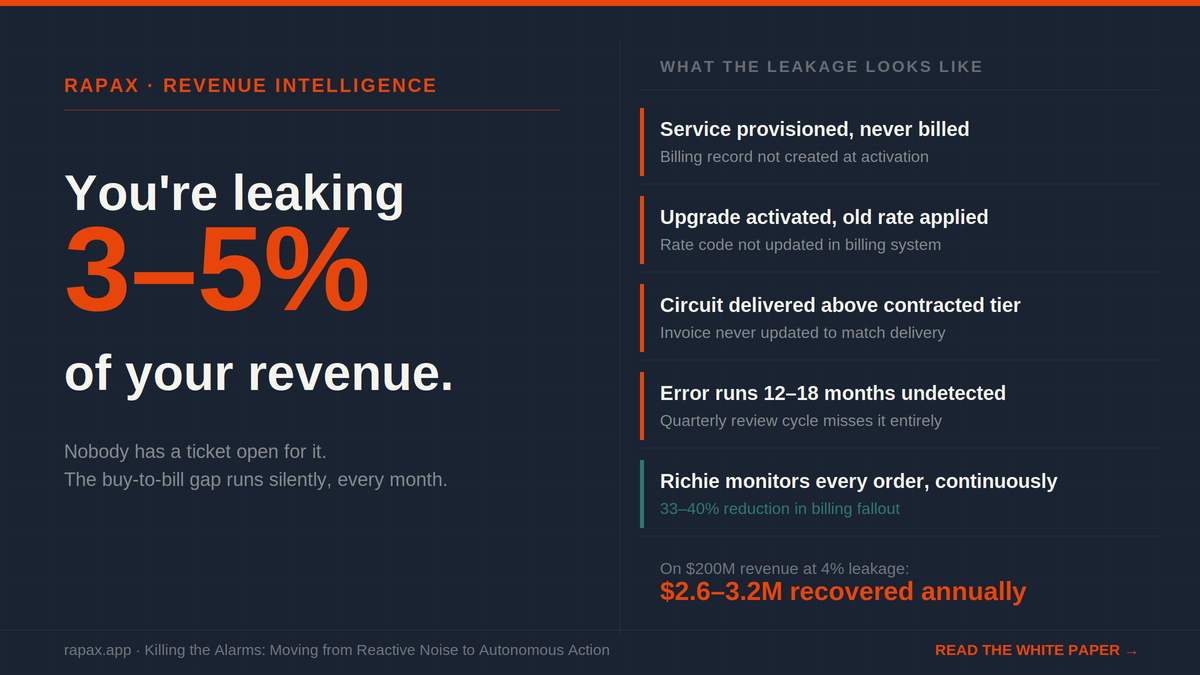
For a typical carrier, that figure runs between 3% and 5% of annual revenue. On a $200 million revenue base, that is $6 to $10 million per year leaving the building quietly, one provisioning error at a time.
How Revenue Disappears Without Triggering an Alarm
To understand why this problem is so persistent, you have to understand the buy-to-bill cycle — the sequence of steps that runs from a customer ordering a service to that service appearing correctly on an invoice and being collected.
In a manual operational environment, that cycle touches multiple systems: the order management platform, the provisioning engine, the network inventory, the service activation layer, and finally the billing system. Each handoff between those systems is a point where data can be lost, mismatched, or delayed. A service gets provisioned to the network but the billing record is not created. An upgrade is activated but the new rate code is not applied. A circuit is delivered at a higher bandwidth tier than was ordered, and nobody updates the invoice to reflect what was actually delivered.
None of these events generate an alert. The network is working. The customer is receiving service. The provisioning system shows the order as complete. Only the billing system knows something is wrong — and the billing system only knows what it has been told.
This is the buy-to-bill gap. And in an environment where those handoffs are managed manually, across multiple platforms that do not natively communicate, the gap is not an anomaly. It is a structural feature of the operational model.
Why Manual Billing Review Catches a Fraction of It
Most carriers have some version of a billing integrity process. A team — usually sitting somewhere between finance and operations — periodically reviews orders, reconciles provisioning records against billing records, and investigates discrepancies. This team works hard and catches real problems.
The issue is the math. A carrier processing hundreds or thousands of service orders per month, across multiple product lines, across a multi-vendor network, generates a reconciliation surface that a human team cannot fully cover on a practical review cycle. They prioritize. They focus on the largest accounts, the most recent orders, the highest-visibility products. The smaller accounts, the older orders, the edge cases — those stay in the backlog, or they do not make the cut at all.
The 3–5% revenue leakage figure is not a reflection of how hard the billing integrity team is working. It is a reflection of how much surface area exists relative to the human bandwidth available to cover it. The team is doing exactly what it can do. The problem is that what it can do is not enough to close the gap.
The Compounding Problem: Un-Billed Services Run Indefinitely
Here is the part of this that most CFOs find most uncomfortable when they see it clearly for the first time: an un-billed service does not fix itself.
If a customer is activated at the wrong rate code in January, they will still be at the wrong rate code in March, in July, and in December — unless someone specifically identifies the error and corrects it. The revenue leakage from that single provisioning error is not a one-time event. It is a recurring monthly loss that compounds for as long as the service remains active and uncorrected.
In a carrier with a large installed base and a billing review process that operates on a quarterly or semi-annual cycle, it is entirely possible for a provisioning error to run for 12 to 18 months before it surfaces. By then, the revenue that should have been collected is gone. Depending on the contractual terms and the nature of the error, retroactive recovery may be limited or impractical.
The question a CFO should be asking is not “how much did we lose last quarter to billing fallout?” It is “how much is currently running in our base that we do not know about?” Those are different questions, and the second one is the one that matters.
What Autonomous Revenue Integrity Looks Like
The Richie agent inside Rapax — Revenue Integrity — was built specifically for this problem. Its operational mandate is continuous monitoring of the buy-to-bill cycle: tracking every service order from activation through billing, identifying gaps where provisioning and billing records do not align, and escalating discrepancies for resolution before they become entrenched.
The distinction between what Richie does and what a manual billing review team does is not speed — it is coverage. Richie monitors every order, on every account, across every product line, continuously. Not quarterly. Not on a sampling basis. Every transaction, every cycle, in real time.
When a provisioning record does not produce a corresponding billing record within the expected window, Richie flags it. When a service is activated at a tier that does not match the contracted rate, Richie flags it. When a circuit has been running for more than 30 days without a confirmed billing match, Richie escalates it. The human team reviews the exception queue and resolves — rather than spending their time generating it.
Autonomous detection of billing fallout at this coverage level reduces revenue leakage by 33 to 40%. For a carrier running $200 million in annual revenue with a current 4% leakage rate, that is a $2.6 to $3.2 million annual recovery — recurring, compounding, and achieved without adding headcount to the billing integrity team.
The CFO Conversation This Changes
There are two versions of the CFO’s relationship with network operations. In the first version, the network is a cost center — a necessary operational expense that consumes capital and produces infrastructure. The CFO’s job is to manage it down. In the second version, the network is a revenue engine that is either performing at its full potential or leaking value at a rate that can be measured and closed.
Most carrier CFOs are living in the first version because the operational model does not give them the visibility to live in the second one. The billing review team reports what it found. It cannot report what it did not have time to look at.
Richie changes that. When the buy-to-bill cycle is monitored autonomously and continuously, the CFO is no longer managing a cost center with an opaque revenue integrity risk. They are managing a revenue engine with a known, measurable, and improving leakage rate. That is a different conversation with the board. It is a different story for investors. And it is a different number on the P&L.
The full revenue integrity model — what Richie monitors, how it integrates with the broader agent fleet, and what the complete financial impact looks like alongside NOC labor reduction and truck roll avoidance — is in the white paper below.
Download: Killing the Alarms — Moving from Reactive Noise to Autonomous Action →
If any of this lands and you want to talk about what it means for your operation — 15 minutes at cal.com/shawn-ennis. No prep needed.
Leave a Reply