
There is a senior network architect at nearly every carrier I have worked with over the past 25 years. He — and it is almost always a he, in his mid-to-late fifties — has been with the company for a long time. He was there when the Nokia NMS was installed. He was there when the legacy billing platform was integrated with the OSS. He was there when the SNMP trap feed was configured to route through the mediation layer, and he remembers exactly why it was configured the way it was, even though it does not make obvious sense to anyone reading it today.
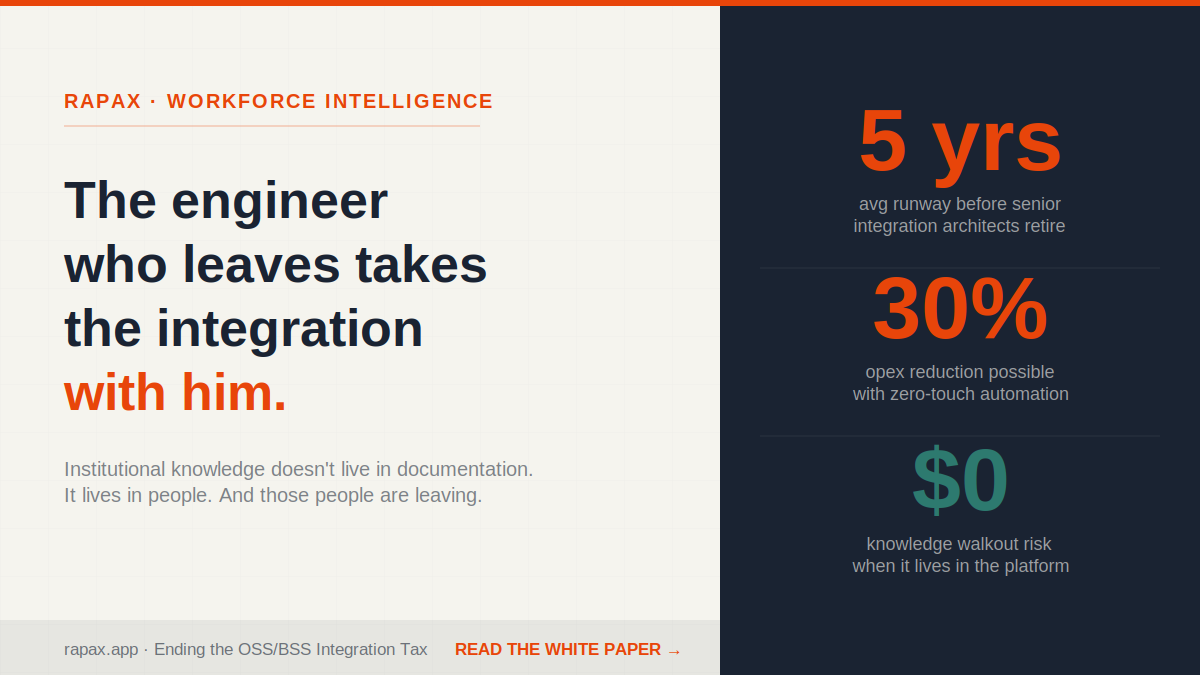
He is also, in most cases, three to five years from retirement.
When he goes, a very specific kind of institutional knowledge goes with him. Not the kind that lives in documentation — the kind that lives in memory. The workaround that was built because of a vendor limitation that was never formally acknowledged. The field mapping that was adjusted after a production incident in 2017 that nobody wrote a postmortem for. The reason the alarm suppression window is set to 47 seconds instead of 60.
That knowledge is not written down anywhere. And when it is gone, it is gone.
Integration Knowledge Is Not the Same as Network Knowledge
Most organizations have a plan for preserving network knowledge. Topology maps, device inventories, configuration management databases — these are well-understood disciplines with tooling and process behind them. The average VP Engineering has thought about what happens when a senior network engineer retires.
What they have thought less carefully about is what happens when the senior integration engineer retires.
Integration knowledge is different. It is not about what the network looks like — it is about how the systems that manage the network talk to each other. It is the accumulated understanding of why a specific SNMP community string is used for one device class and a different one for another. Why the syslog receiver is configured to accept RFC 3164 from one set of network elements and RFC 5424 from another. Why the API poller runs on a 90-second interval for Nokia devices and a 4-minute interval for Calix — a timing decision made years ago to avoid hammering the NMS during peak traffic windows, and never documented because it seemed obvious at the time.
This knowledge was not written down when it was built, because the person who built it did not expect to leave. And it was not written down later, because the person who built it was too busy maintaining it to document it.
What Happens When the Knowledge Gap Becomes a Staffing Crisis
Nokia Bell Labs research projects that zero-touch network initiatives could reduce operational expenditures by up to 30% by 2026. That figure is real — but capturing it requires making an architectural shift before the knowledge gap compounds into a staffing crisis.
Here is the sequence of events that most carriers are already in the early stages of:
A senior integration architect retires or departs. Their integrations continue running because they were built well. For 12 to 18 months, nothing breaks badly enough to require deep knowledge of the original implementation.
Then something changes upstream. A vendor releases a firmware update. An API is versioned. A platform is upgraded. The integration breaks or degrades — and nobody in the current organization fully understands how it was built or why it was configured the way it was.
The SI firm is engaged. But the SI firm does not have the institutional context either. They are starting from scratch — reading configuration files, reverse-engineering data flows, asking questions that the retired engineer could have answered in five minutes. The engagement takes longer and costs more than it would have three years ago.
This is not a hypothetical scenario. This is the active operational reality at a significant portion of Tier 2 and Tier 3 carriers in North America today. The engineers who built the integration layer of the modern telecom stack are aging out. The window to capture the institutional knowledge they carry is closing — and most organizations are not moving fast enough to capture it.
The Structural Problem: Knowledge That Lives in People Cannot Scale
The workforce issue exposes a deeper architectural flaw. In every integration model that has existed in telecom to date — SI firms, internal teams, iPaaS platforms, homegrown tooling — the integration knowledge lives in people. The human is not a layer above the integration. The human is the integration.
That is what makes the knowledge loss so damaging. When the person who built an integration departs, they do not leave behind a well-structured codebase that a junior engineer can extend. They leave behind a working system whose inner logic was never externalized — because externalizing it was never part of the job.
Breaking this dependency requires a fundamentally different architecture. One where the machine carries the integration knowledge — where every integration that is built, deployed, and verified adds to an accumulated operational context that does not walk out the door when a senior engineer retires.
Where the Knowledge Should Live Instead
The Bruce capability inside Rapax was built on a specific premise: integration knowledge should live in the platform, not the person. Every integration Bruce builds — every Nokia trap adapter, every Calix GPON poller, every ServiceNow ticketing bridge — is committed to version control, documented in a structured knowledge base, and available as context for every subsequent integration that draws on similar patterns.
When a Calix firmware update changes the YANG model for GPON OLTs, Bruce detects the schema change, identifies the affected fields, and proposes remediation without requiring a human who remembers why the original integration was built the way it was. The institutional context is in the platform. It does not retire. It does not roll off at the end of a project. It compounds.
The carrier that deploys this model three years before their senior architect retires is in a fundamentally different position than the carrier that deploys it three years after. The window is not closed — but it is narrowing.
The full financial model for what institutional knowledge loss actually costs a mid-size Tier 2 operator — and what the alternative architecture looks like in practice — is in the white paper below.
Download: Ending the OSS/BSS Integration Tax →
If any of this lands and you want to talk about what it means for your operation — 15 minutes at cal.com/shawn-ennis. No prep needed.
Leave a Reply