
Think about the last time you looked at your NOC team’s actual workload — not the job descriptions, not the org chart, but what they spent their hours doing last Tuesday.
Alarm triage. Ticket routing. Configuration verification. Scheduled health checks. Escalation bridges for events that turned out to be nothing. Manual correlation of fault data across systems that do not talk to each other. Documentation updates that were three weeks behind before anyone started them.
Now think about what was sitting in the backlog while that work was happening. Network densification planning. New service architecture for an enterprise customer who has been waiting six weeks for a scoping call. The 5G buildout timeline that keeps slipping because the team that should be designing it is busy keeping the current network running.
That gap — between what your senior engineers are doing and what you need them to be doing — is not a staffing problem. You cannot hire your way out of it. It is a model problem. And the model is costing you more than the headcount line on your P&L suggests.
The Janitorial Labor Tax
I did not invent the term “network janitorial work.” I borrowed it from the operations leaders I have spent 25 years working alongside — the people who use that phrase, usually with some combination of resignation and frustration, when they describe what their best engineers actually spend their days doing.
The math behind it is straightforward. Elite network engineering talent — the architects, the senior NOC engineers, the operations specialists who understand your multi-vendor environment at depth — carries a fully loaded cost of $120,000 to $200,000 per year per head at most carriers. When you account for benefits, overhead, and the management cost of that team, you are spending somewhere between $2 million and $6 million annually on a team that exists to keep the network running.
The question worth asking is: how much of that spend is actually keeping the network running versus cleaning up after the processes and systems that are supposed to do that work automatically?
The answer, for most carriers operating on a traditional NOC model, is uncomfortable. The majority of NOC engineering hours at an operator are consumed by network tasks — the repetitive, rule-based, lower-judgment work that fills the queue every shift. Alarm acknowledgment. Known-fault ticket creation. Standard escalation workflows. Health check execution. These are tasks that follow documented procedures. They require familiarity with the systems, but they do not require the depth of expertise you are paying for.
The high-value work — the architecture decisions, the capacity planning, the new product enablement, the vendor evaluation, the customer-facing technical engagement — happens in the margins. When there is time. Which there often is not.
What the Error Premium Actually Costs
Here is the part of this conversation that makes operations leaders uncomfortable: the janitorial model does not just waste engineering capacity. It actively degrades network reliability.
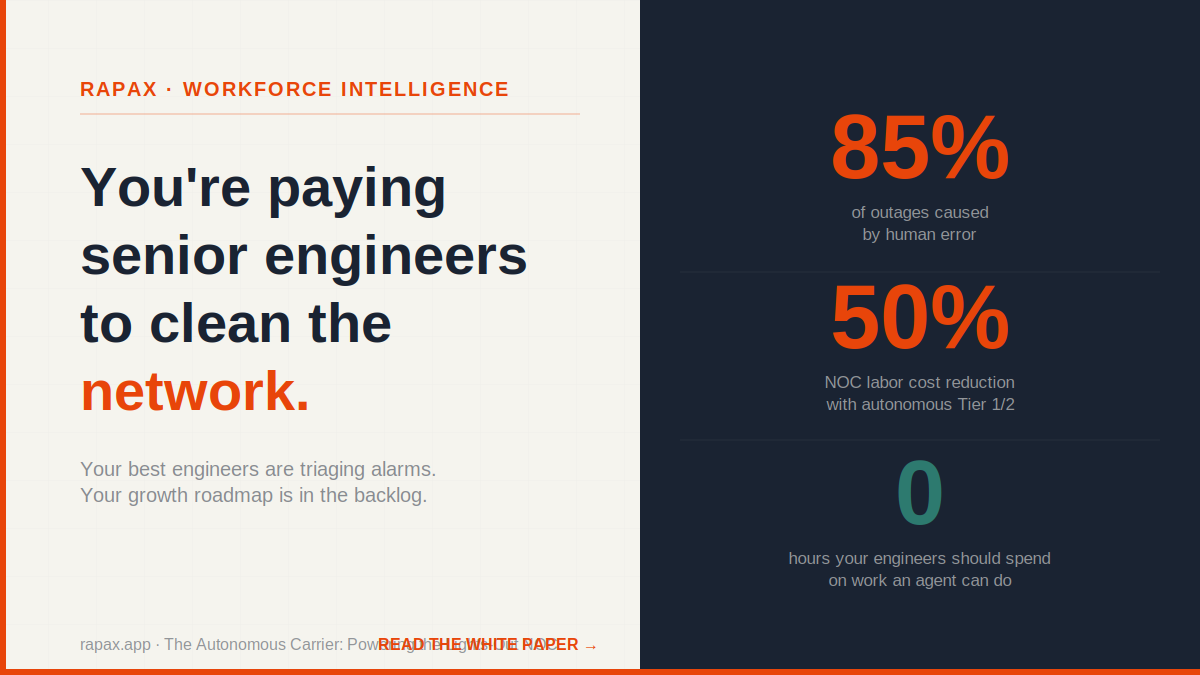
Industry analysis consistently shows that roughly 85% of human-error-related network outages are caused by staff failing to follow or misinterpreting complex operational procedures. Not sabotage. Not negligence. Complexity applied to humans at scale, under time pressure, on a rotating shift schedule, produces errors at a statistically predictable rate. The more manual touchpoints in your operational model, the more surface area for that error rate to compound.
Every one of those errors carries a cost that does not show up on the headcount line. Truck rolls that could have been avoided. Overtime for emergency remediation. SLA penalties on enterprise contracts. Customer churn from service degradation that should have been caught before it became an outage. The Uptime Institute estimates that a single significant outage attributable to human configuration error costs a mid-size carrier between $100,000 and $500,000 when you account for all direct and indirect costs.
Multiply that by the frequency of human-error events in a year, and the error premium is a material line item that most carriers are not tracking as a single number — because it is distributed across incident response budgets, SLA credits, overtime accounts, and truck roll costs that each look small in isolation.
The Shift That Changes the Economics
The operational model that breaks this dynamic is not one where you reduce headcount. That is not the point, and it is not what the best-run carriers are doing with this.
The model that works is one where you redeploy the headcount. Where network events — the known fault types, the standard escalation workflows, the configuration verification tasks, the scheduled health checks — are handled by AI agents that execute faster, more consistently, and without the error rate that human fatigue and procedural complexity introduce. And where your senior engineers are freed to do the work that actually requires them.
The Agentic NOC model makes this concrete. When a fiber backhaul event triggers, the orchestration agent does not open a ticket and wait for a human to triage it. It correlates the fault across the network layer, identifies the affected services, reroutes traffic where rerouting is possible, adjusts wireless coverage on adjacent cell sites to compensate for lost wired capacity, initiates the RMA workflow for the affected hardware, and schedules the field technician. By the time a human looks at it, the autonomous response is complete and documented. The engineer reviews the outcome. They do not manage the process.
That shift — from managing process to reviewing outcomes — is what releases the engineering capacity that is currently locked in the janitorial model. Early implementations of this architecture are demonstrating a 30 to 50% reduction in manual triage and resolution tasks, with some carriers seeing NOC labor costs cut by half when network issues move to autonomous resolution.
That is not headcount reduction. That is headcount reallocation — from cleaning the network to building the next one.
The CFO Version of This Conversation
There is a version of this argument that lands differently in a finance conversation than in an operations conversation, and it is worth stating it plainly.
The current operational model ties labor cost to network scale. Every time you expand the network — add a new market, onboard an acquisition, densify an existing footprint — you add operational surface area that the NOC has to cover. Which means you add headcount. Which means your OpEx grows with your network, which is exactly the dynamic that is compressing margins across the sector.
The agentic model breaks that coupling. Carriers that have made the architectural shift can double their network footprint without doubling their NOC headcount — because the agents scale with the network in a way that human teams cannot. That is the growth-at-scale story that changes the investor conversation: not that you are cutting costs, but that you have decoupled your operational cost structure from your growth trajectory.
BCG analysis puts the productivity lift from AI-assisted field operations and smart dispatching at 20 to 30%. When combined with autonomous network resolution, the NOC labor cost reduction potential reaches 40 to 50% of current spend. For a carrier running a $4 million annual NOC labor budget, that is $1.6 to $2 million in redirectable capital — available for fiber buildout, 5G densification, or the enterprise product capability that has been in the backlog for two years.
The full workforce reallocation case — what the post-transformation NOC actually looks like for the Ops Executive, the CFO, and the field team, and what the realistic savings targets are through 2027 — is in the white paper below.
Download: The Autonomous Carrier — Powering the Lights-Out NOC →
If any of this lands and you want to talk about what it means for your operation — 15 minutes at cal.com/shawn-ennis. No prep needed.
Leave a Reply