
By Shawn Ennis | Rapax
I have been on both sides of the OSS/BSS procurement table. I know how these conversations go.
The vendor demo looks right. The reference calls are positive. The contract gets signed. The implementation begins. And six months later, the scope has drifted, the timeline has slipped, and the operator is discovering that what they are getting is not quite what they thought they were buying — but the contract does not have an exit clause that accounts for that.
This is not a story unique to any one vendor or any one operator. It is a structural feature of how enterprise software procurement has always worked: payment precedes proof, and the risk of non-delivery sits almost entirely with the buyer. By the time you know whether you got what you paid for, you have already paid.
I built the Rapax commercial model to break that pattern. Not because it is good marketing — because it is the only model that makes sense when you are genuinely confident the product delivers.
How It Works
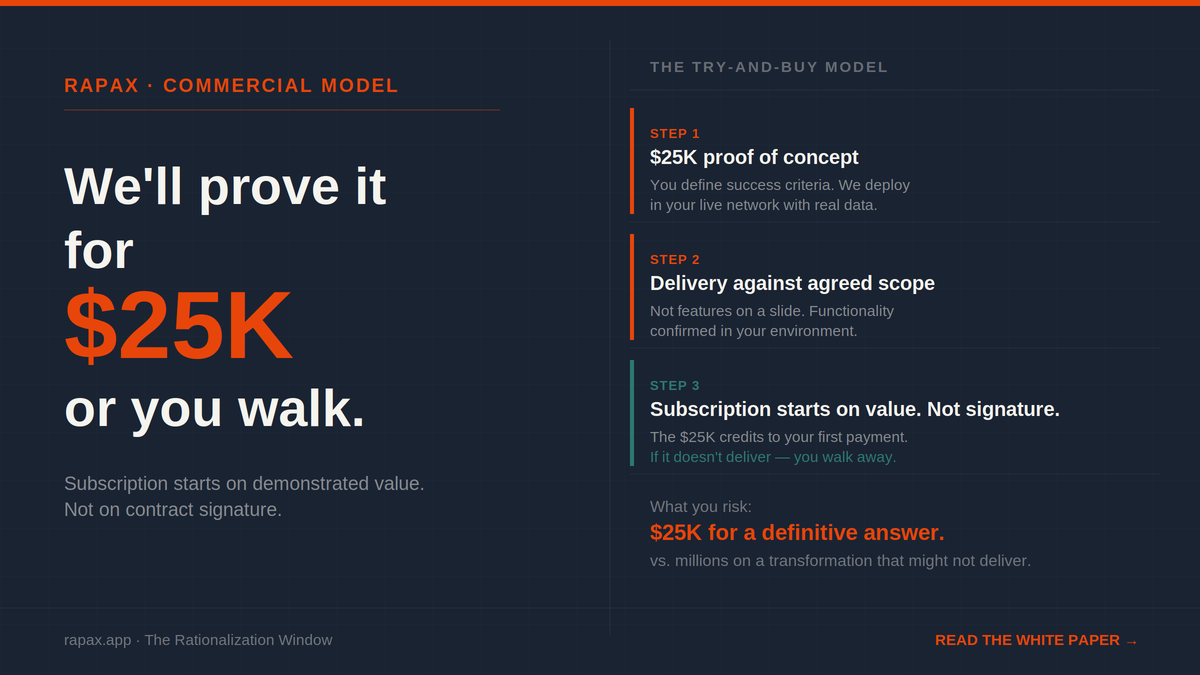
Step 1: A $25,000 proof of concept scoped to your requirements. The conversation starts not with a proposal but with a definition of success. What tools are you looking to replace? What capabilities need to be demonstrated? What integrations need to be validated? What does “this works” look like in your specific environment? You define the criteria. We deploy against them — in your live network, with your real data, against your actual device inventory. Not in a lab. Not with synthetic traffic.
Step 2: Delivery against the agreed scope. The proof of concept runs until Rapax has demonstrated the functionality agreed to during scoping. Not a subset of it. Not a roadmap item that will be available next quarter. The agreed scope, confirmed operational, in your environment. The measure of completion is your confirmation that the platform performs as agreed — not a feature list we check off internally and ship.
Step 3: Subscription begins on demonstrated value. The commercial relationship does not start on contract signature. It starts when you confirm the platform is delivering what was agreed. The $25,000 proof of concept investment credits directly to the first subscription payment. If the proof of concept does not meet the agreed criteria, you walk away. You have spent $25,000 on a definitive answer about whether this platform belongs in your environment. That is a different risk profile than the alternative.
What You Are Actually Risking
The standard objection to a $25,000 proof of concept is that it still represents a financial commitment to a vendor relationship that might not work out. That objection is worth taking seriously.
Consider the alternative. The typical OSS/BSS evaluation cycle — RFP process, vendor presentations, reference checks, contract negotiation, legal review — consumes three to six months of internal engineering and procurement time before a single line of code is deployed in your environment. The cost of that process, in internal labor alone, frequently exceeds $25,000 before the first invoice arrives. And at the end of that process, you still do not know whether the platform works in your environment — because it has not been deployed there yet.
The $25,000 proof of concept replaces that evaluation cycle with something more useful: a running deployment in your actual environment, against your actual requirements, with a defined exit if it does not perform. You spend the same or less than a traditional evaluation process, and you end up with either a deployed solution or a clear answer — not a signed contract and eighteen months of uncertainty.
Why This Model Filters for the Right Conversations
The try-and-buy model is not just about risk reduction for the operator. It is about alignment between both parties from day one.
Operators who engage on this model have a real problem they need to solve. They have looked at their tool landscape, added up the five cost layers of what their legacy platforms are actually costing them, and concluded that the replacement math could work if the platform delivers. They are not evaluating Rapax as an exercise — they are evaluating it because they intend to deploy if it performs.
That is the conversation I want to have. Not the evaluation that was always going to end in a deferred decision. Not the RFP response that goes into a drawer. A real operational problem, a defined proof of concept, and a commercial relationship that starts when value is demonstrated.
The operators who are not sure yet get a $25,000 answer instead of a million-dollar guess. That is a reasonable trade for everyone involved.
The Risk Profile in Plain Language
If Rapax delivers against the agreed proof of concept scope: you have a running deployment, a confirmed business case, and a subscription that starts at terms you negotiated before the engagement began. The $25,000 is gone — applied to the first payment.
If Rapax does not deliver against the agreed scope: you walk away. You have spent $25,000 and you know definitively that this platform is not the right fit for your environment at this time. You have not committed to a multi-year subscription. You have not gone through an eighteen-month implementation that failed. You have a clear answer, a defined cost, and the freedom to evaluate other options without a contractual anchor.
That is the risk calculus. Most operators who run through it conclude that $25,000 for a definitive answer in their live environment is the most efficient procurement decision they have made in years.
“You already know which tools you want to eliminate. You already know what they cost. The question is whether the replacement math works. A 15-minute conversation is enough to find out.”
What the Conversation Looks Like
The most useful starting point is not a product demo. It is a 15-minute conversation about your current tool landscape: what you are running, what it costs you across the five layers described in the previous post in this series, and which tools you would decommission first if the replacement math worked out. From that conversation, we can determine whether a proof of concept makes sense, what its scope would look like, and what the realistic savings profile is for your specific environment.
No prep needed. No slide deck. Just a conversation between two people who have been through enough OSS/BSS procurement cycles to know what matters and what does not.
The full commercial model — including the three savings scenarios from single tool replacement to full operational transformation — is in the white paper below.
The Rationalization Window
Turning OSS/BSS Tool Sprawl Into AI-Native Savings
Ready to run the replacement math on your environment? 15 minutes at cal.com/shawn-ennis. No prep needed.
Leave a Reply