
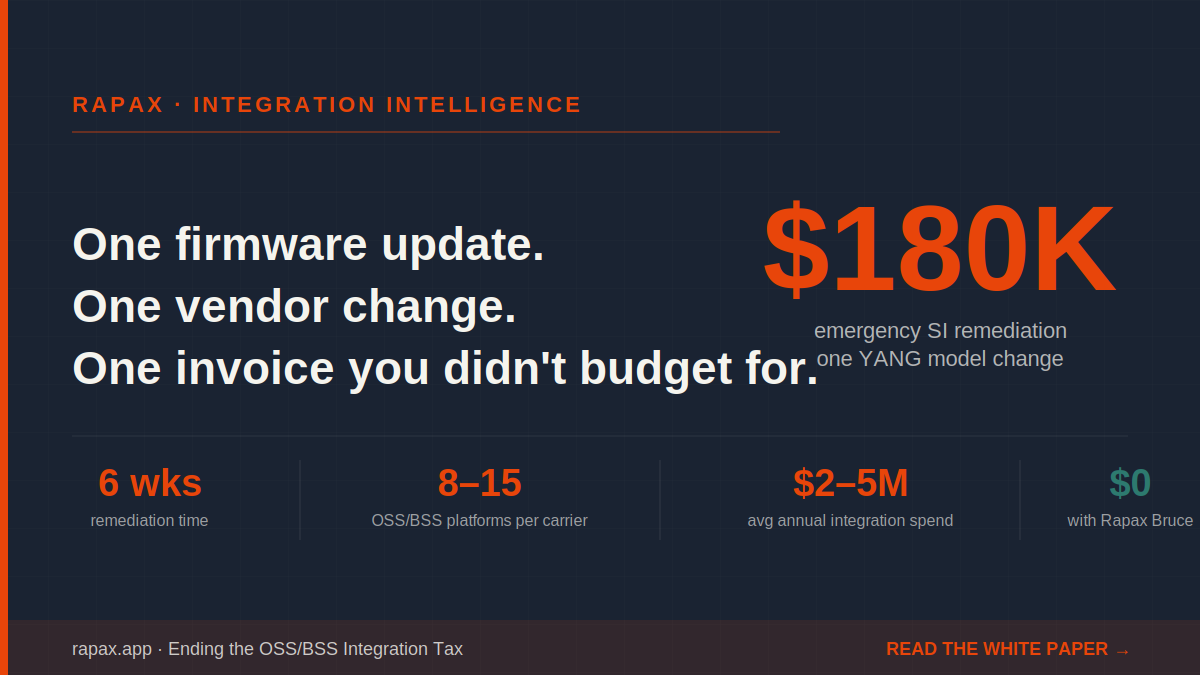
Calix pushed a firmware update. Standard release cadence — nothing unusual. Somewhere in the release notes, buried in a changelog that nobody had time to read that week, was a line about a YANG model change for GPON OLTs.
Six weeks later, a carrier I know well was cutting a check to their systems integrator for $180,000.
Not because the network went down. Not because the update failed. Because the integration between their Calix management platform and their OSS stack silently broke — and nobody caught it until a field technician noticed that provisioning data wasn’t matching what the system showed. By then, the damage was done: six weeks of degraded operational visibility, a scrambled root cause analysis, an emergency SI engagement, and an unplanned invoice that wrecked the Q2 opex budget.
This is not a horror story. This is a Tuesday.
The Anatomy of an Integration Failure Event
Here is what actually happens when a vendor changes something upstream:
The change ships. Your integration doesn’t know — it was built to a previous spec and nobody told it the spec changed. Alarms may still flow. Data may still appear to move. The failure is often silent, which is the worst kind.
Discovery happens through a symptom, not a monitor. A technician questions a discrepancy. A manager notices a report that doesn’t add up. A customer calls. By the time the failure surfaces, you’ve already lost days or weeks of reliable operational data.
The scope assessment begins. Someone — usually a senior engineer who has three other things open — has to figure out exactly what broke, which vendor version introduced the change, what fields are now mapped incorrectly, and what the remediation requires. This is not a quick conversation.
The SI engagement is contracted. If you have an internal team, they may own the fix — but internal integration engineers are rarely sitting idle waiting for emergency work. Most carriers call their SI firm. The clock starts. Day rates for senior integration architects run $150 to $300 per hour. A contained remediation takes two to four weeks of elapsed time. A complex one takes longer.
The invoice arrives. For a YANG model change on a GPON OLT platform, $180,000 is not an outlier. It is a reasonable mid-range estimate for emergency SI work, internal engineering diversion, and the operational cost of the gap period.
The Structure of the Problem Is Not the Incident
Here is the thing that took me 25 years to fully see clearly: the $180,000 is not the problem. The $180,000 is the symptom.
The problem is that vendor changes are not accidents. They are the normal operating cadence of any technology platform. Calix will release firmware again. Nokia will deprecate an API. Netcracker will update their data model. Salesforce will version their REST endpoints. This is not negligence — this is how software works.
Your integration layer was built to a specific version of the world. The world keeps changing. Every time it does, someone pays to reconcile the gap.
A typical Tier 2 or Tier 3 carrier today manages between eight and fifteen OSS/BSS platforms simultaneously. Each one has its own release cadence. Each one has integrations that depend on assumptions that were true when they were built. The math is straightforward: the more platforms you run, the more integration touch points you maintain, the more often the world changes in ways that break something.
This is what the industry calls integration debt. And unlike technical debt, it does not depreciate toward zero over time. It compounds.
Why Nothing Has Fixed This
The standard responses to this problem are well-established, and none of them break the underlying dynamic.
Systems integrators are expensive, specialized, and they roll off when the project ends. The knowledge they bring walks out the door with them. The next change event triggers a new engagement. The relationship does not end — the invoices just keep coming.
iPaaS platforms — MuleSoft, Boomi, Azure Integration Services — reduce the tooling cost of integration but not the expertise cost. Building a NETCONF adapter for a Nokia 7750 SR still requires someone who understands YANG models, the specific firmware version in your environment, and how your network names things. The platform provides the container. It does not supply the knowledge.
Internal integration engineering teams are the most resilient model — until staff turnover carries the institutional knowledge out the door, or until the backlog of new integration work outpaces the team’s capacity to maintain what already exists.
What all of these approaches share is a dependency on specialized human expertise at every integration event. The human is not a control layer sitting above the integration. The human is the integration. When the YANG model changes, a human reconfigures it. When the API versions, a human remaps the fields. When the firmware ships, a human reads the changelog so the system does not have to.
That makes integration costs structurally linear with integration activity — and integration activity in a heterogeneous network only increases over time.
A Different Model Exists
I built Rapax because I spent two decades watching this problem recur — at carriers of every size, across every vendor mix, on every platform generation. The integration tax is not a failure of execution. It is a failure of architecture.
What breaks the dynamic is not a smarter SI firm or a better middleware platform. It is a platform where the integration knowledge lives in the system — not the engineer — and where a vendor change triggers adaptation, not an invoice.
That is what the Bruce capability inside Rapax is built to do. Not to generate plausible-looking code. To build, deploy, verify, and maintain production integrations in your environment — and to handle the change events that will inevitably come, without a six-week remediation cycle and without a $180,000 invoice.
The financial model for what this actually costs a mid-size Tier 2 operator — across SI services, maintenance, internal headcount, and downtime — and what it looks like when that spend goes to zero, is in the white paper below.
The integration tax on telecom operations is not a new problem. What is new is that there is a productized, proven path to eliminating it. Read the full analysis — including a complete financial model for a regional Tier 2 operator — in our white paper.
Download: Ending the OSS/BSS Integration Tax
If any of this lands and you want to talk about what it means for your operation — 15 minutes at cal.com/shawn-ennis. No prep needed.
Leave a Reply